
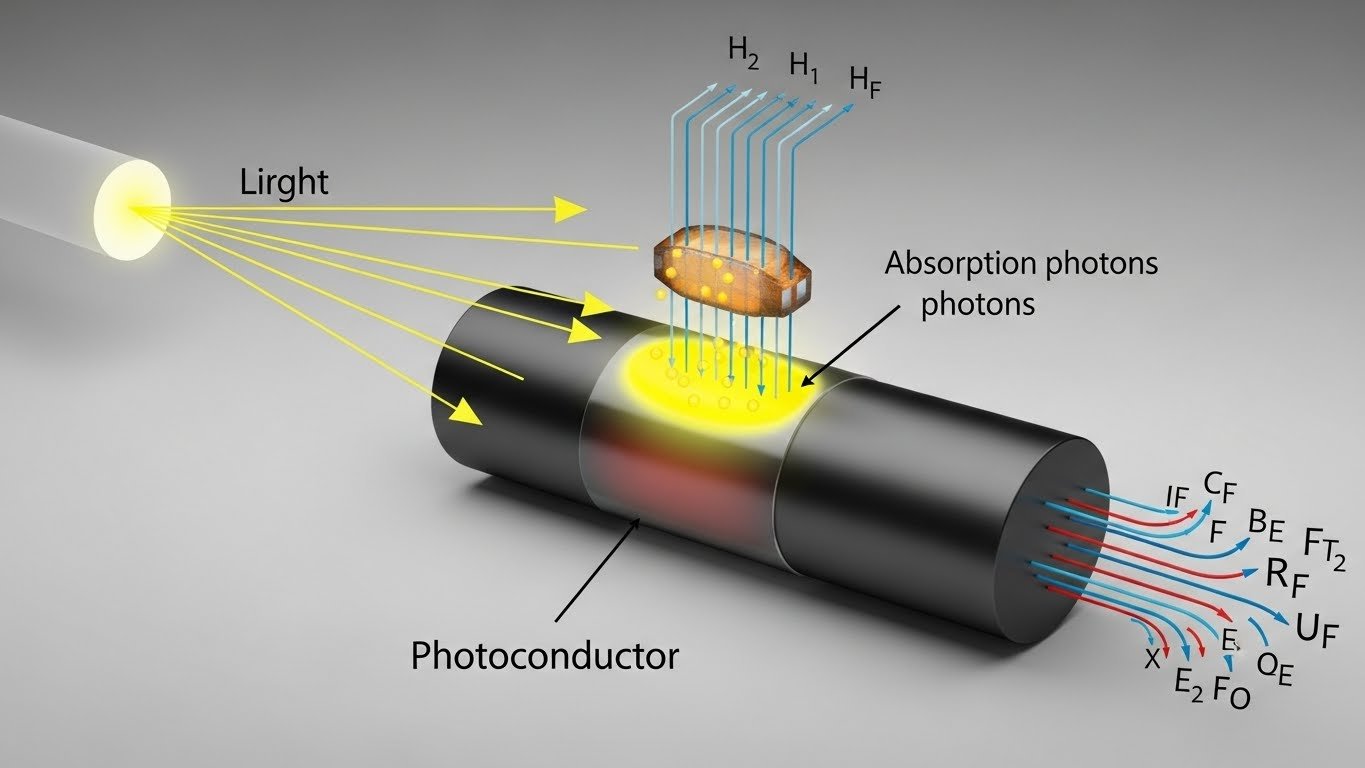
Understanding what is photoconductor in physics is important for anyone studying modern electronics, optics, or solid-state physics. This concept explains how light can directly influence the electrical behavior of certain materials. Photoconductors are widely used in sensors, imaging systems, and light-detection technologies, making them a core topic in both academic learning and real-world applications.
Introduction to Photoconductors
To understand what is photoconductor in physics, we first need to look at how materials respond to light. A photoconductor is a material whose electrical conductivity increases when it is exposed to light. In darkness, the material has relatively high resistance, but when light falls on it, charge carriers are generated, allowing current to flow more easily. This property makes photoconductors extremely useful in devices that rely on detecting or measuring light intensity.
Basic Principle Behind Photoconductivity
The principle behind what is photoconductor in physics lies in energy absorption. When light with sufficient energy strikes a photoconductive material, it excites electrons from the valence band to the conduction band. This process creates free electrons and holes, which act as charge carriers. As the number of charge carriers increases, the electrical conductivity of the material also increases. Once the light source is removed, the electrons return to their original state, and the conductivity decreases again.
Types of Photoconductive Materials
When studying what is photoconductor in physics, it is important to know that photoconductive materials can be classified into two main types: intrinsic and extrinsic. Intrinsic photoconductors are pure materials like silicon or germanium, where conductivity increases due to electron excitation within the same material. Extrinsic photoconductors contain impurities that introduce energy levels within the band gap, allowing them to respond to lower-energy light. Both types are used depending on the wavelength and sensitivity required.
Photoconductors vs Semiconductors
Many students confuse what is photoconductor in physics with general semiconductor behavior. While all photoconductors are semiconductors, not all semiconductors act as photoconductors. A photoconductor is specifically designed or used for its light-sensitive conductivity. Regular semiconductors may not show significant conductivity change under light unless modified or doped appropriately. This distinction is crucial in device design and physics applications.
Common Examples of Photoconductors
To better grasp what is photoconductor in physics, consider common examples such as cadmium sulfide (CdS), cadmium selenide (CdSe), silicon, and lead sulfide. Cadmium sulfide is widely used in light-dependent resistors, while silicon-based photoconductors are common in imaging and optical sensors. These materials are chosen based on their response time, sensitivity, and operating wavelength.
Applications in Real Life
The practical importance of what is photoconductor in physics becomes clear when we look at its applications. Photoconductors are used in light meters, automatic street lighting systems, infrared detectors, and medical imaging devices. They are also found in security systems and optical communication equipment. Their ability to convert light signals into electrical signals makes them essential in modern technology.
Advantages and Limitations
While learning what is photoconductor in physics, it is equally important to understand its strengths and weaknesses. Photoconductors are simple in design, cost-effective, and highly sensitive to light. However, they may have slower response times compared to photodiodes and can be affected by temperature changes. These limitations must be considered when selecting a photoconductor for specific applications.
Role in Physics Education and Research
From an educational perspective, what is photoconductor in physics helps students understand the interaction between light and matter. It connects concepts like energy bands, charge carriers, and conductivity in a practical way. In research, photoconductors are used to develop advanced sensors and explore new materials with improved light sensitivity.
Conclusion
In summary, what is photoconductor in physics refers to the study of materials whose electrical conductivity changes under light exposure. This behavior is explained by electron excitation and charge carrier generation. Photoconductors play a vital role in technology, education, and scientific research. By understanding their principles, types, and applications, students and professionals can better appreciate how light-driven electrical systems shape the modern world.